
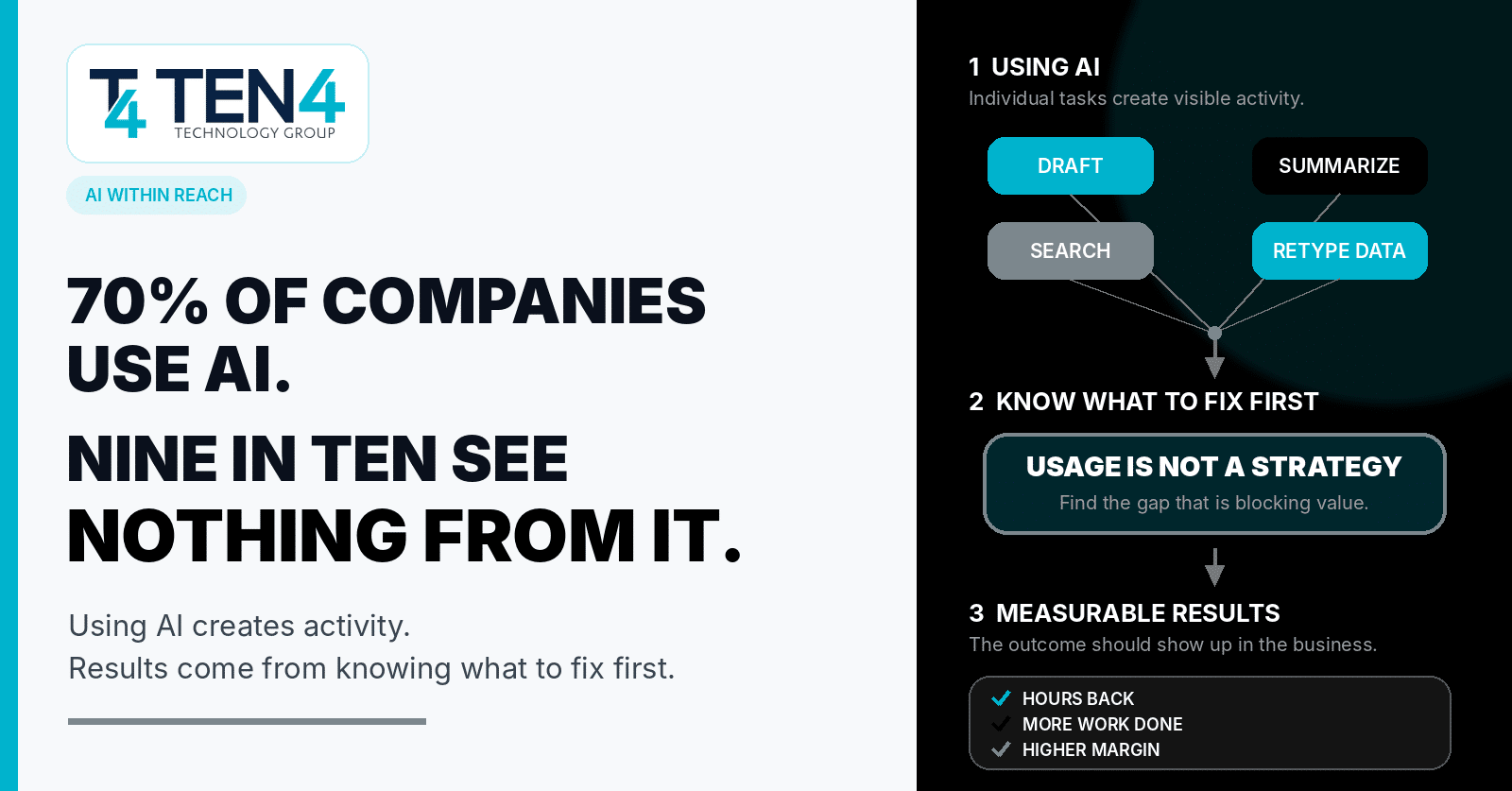
Ask a room of business owners whether their company uses AI, and nearly every hand goes up.
Ask them what it’s actually returned — in hours back, in margin gained, in work getting done that didn’t get done before — and the room goes quiet.
The National Bureau of Economic Research put that exact question to nearly 6,000 senior executives at the start of this year. Seventy percent of their companies actively use AI. Nine in ten reported no measurable impact on productivity or employment over the previous three years.
That’s not a rounding error. That’s the entire story of where this market stands right now. And if you’re being honest with yourself, you probably already know which side of that gap your business sits on.
Activity Is Not Maturity
Here’s the trap. Usage is easy to see and easy to feel good about. Someone on your team drafted a proposal faster. Someone summarized a call. If you had a dashboard, it would look busy.
But busy isn’t the same as better. What most companies actually have is what we’d call random acts of AI — individual people solving individual problems, in whatever tool they happened to land on, with no shared thinking behind any of it. That produces exactly what you’d expect: a lot of activity and none of it compounding into anything.
There’s a reason it stalls there, and it isn’t budget. It isn’t that you picked the wrong tool. It’s that nobody ever handed you a picture of what “good” actually looks like, so there’s no way to know where you stand or what should come next. You’re hearing words like “agents” and “autonomous,” and none of it maps to anything happening in your actual business. Without a model, you can’t sequence your next move. Without a sequence, you take steps that don’t build on each other.
That’s not a discipline problem. It’s a missing map.
What the Tenth Company Did Differently
The companies getting real returns from AI didn’t find a smarter model or write better prompts. They did something far less glamorous: they got the order right.
AI value in a small or mid-sized business rests on five things, and they don’t carry equal weight.
- Productivity opportunity. How much of your team’s week goes to work a machine could handle — hunting for a document that already exists somewhere, retyping the same data between two systems, writing the same status update for the eleventh time. This is where the hours are hiding, and it’s the pillar almost nobody measures.
- AI in motion. How many people are actually using the tools, and what happens to a good idea when one person finds it. Does it spread through the team, or does it die at that one desk? A great strategy in a company that doesn’t adopt it is worth nothing.
- AI foundation. Can an AI assistant actually reach your data? This is the quiet one. If your active files live on a local drive or an aging server, AI can’t help you with them — no matter which license you buy. AI can only work with what it can get to.
- Vision and leadership. Someone has to name a specific business outcome AI is supposed to move, and put their name on it. “We should probably be doing something with AI” is not an outcome.
- Trust foundation. The right people seeing the right information, and a team that knows what’s safe to put into a tool in the first place. Not a governance project — a floor.
We’ve watched this play out with businesses across South Florida since 2001, long before AI was the word for it. The pattern repeats with every technology shift: the companies that see real productivity gains aren’t the ones strongest across the board. Nobody is strong across all five. They’re the ones who figured out which pillar was actually holding them back — and fixed that one first, rather than spreading effort evenly across all five.
Your Weakest Pillar Is Not Your Failure
This is the part that changes how the whole thing feels.
When a company discovers its AI foundation is weak — files scattered across three places, half the team on the wrong license, data nobody can locate on demand — the instinct is embarrassment. It reads like a report card, and the reaction is to go quiet and hope nobody looks too closely.
That’s the wrong read entirely. Your weakest pillar isn’t the thing you got wrong. It’s the thing with the most upside still left in it. It’s the highest-leverage move on the board, and usually the fastest one to act on, because once you can see the gap, it’s obvious.
The shape of your profile matters far more than the score itself. Two companies can both land at 40 out of 100 and need completely different next steps — one needs licenses and a file migration, the other needs someone to actually own the outcome. Averages hide that difference. The imbalance is where the value is.
The Step in Front of the Step
Everyone’s being told to “do AI.” Almost nobody is being told what to do first — which is exactly why so much of the spend evaporates.
You don’t need a strategy deck. You don’t need a governance framework. You don’t need an answer for what “agents” even means. You need an honest read on where you stand across those five pillars, and one reachable first step — the kind you can start Monday and actually feel by the end of the month.
Most companies in this spot are sitting on somewhere between four and eight hours per knowledge worker, per week — hours locked up in repetitive admin and information search. Not theoretical hours. Hours your people are spending right now, this week, on work that doesn’t require them.
The question was never whether that time exists. It’s whether you know where it’s hiding.
Find Out Where You Actually Stand
The AI Readiness Assessment is a 12-question, three-minute diagnostic. You’ll get a score out of 100, a breakdown across all five pillars, and a prioritized 90-day plan built around your single highest-leverage gap — not a list of everything that’s wrong.
No login. No sales call required. The report is yours either way.